PT 5 - Nepal 2016 - Final thoughts
Normally I like to spend a few days...
Packing up and heading home
Normally I like to spend a few days after a long cycle trying to absorb the experience and generally ease out of the touring mindset. On this occasion, almost immediately after unpacking my things and settling back into my hotel room, I start to feel restless. I take a long walk through town but it’s just not the same, the hooting, the incessant sales pitches, constant jostling of the crowds and threat of been knocked down in the traffic.

The façade of this trekking tourism area crumbles down around me and for the first time I see that its all an illusion, the traditional buildings, local dress, friendly conversations, colorful merchandise, fake, fake, fake. I know its an overreaction, a symptom of been exposed to the real Nepal for too long, but I can’t stay.

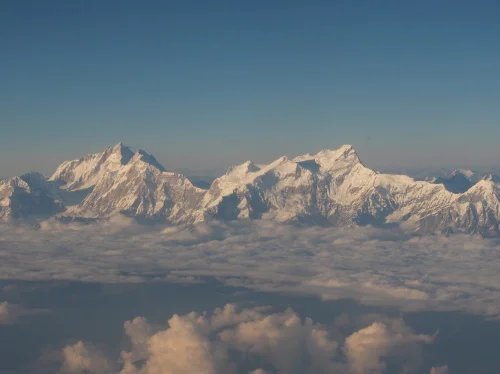
I go online and change all my flight bookings so that I can leave the following day. Later that evening I dismantle my bike but can’t remove one of the pedals, so it’s a really tight fit in the already slightly too small bike bag. The next day, we take off in the late afternoon and fly all along the Himalayan mountain range. I am on the wrong side of the plane, craning my neck to get a glimpse of the mountains when a couple on the correct side see me and offer to change seats for a while. I refuse politely for the required period then accept, jamming my camera up against the window.

There before me, rising above the clouds like a giant crocodile’s tail are the Nepalese Himalayan mountain chain, glistening white and spectacular in the diffused light of a late afternoon. After a brief spell, I go back to my seat and promise to send them a set of photos taken from the plane.
The sun sets, and dinner trolleys are rolling down each of the two isle.
In the final analysis
So now, after some time has gone by, I need to find the answer to two very important questions;
Did I chicken out over the pass?
Does it matter?
To take the first question first.
By the time I got up in the morning before the final push towards the pass, my headache had gone, so probably I would have been ok to have carried on. The weather was clear and expected to be good for the next few days, so chances were that although it would still have been extremely cold, it was unlikely to have turned critically bad. There were many groups of trekkers, guides and porters on the trail by this stage, so I wouldn’t have been completely alone over the pass if I did get into difficulty.
The shortness of breath during that night was definitely a problem related to gaining altitude too fast, but I could have gone back down to Manang and spent another day or two acclimatizing. So taking all that into account, I think I probably could have carried on and safely negotiated the pass, it could have been really cool. So, did I chicken out over the pass?
“Hell yes!”

On the second question;
Although I had heard about the pass before, it had never been a goal of mine to try to cross it on this trip. My intention was to get up close to the mountains just to see for myself what they would look like It was only after I spoke to people in Nepal that I considered it as a possibility and even on the trail when people would ask if I was going to do the pass, my answer was always along the lines of, “I’m just going to keep cycling until I stop, and if that’s the other side of the pass then fine, if not, then also fine” While the landscape and scenery on the Annapurna circuit was breathtaking and the riding just amazing, from a cultural aspect it was all but destroyed. Most of the villages have converted over to tourist towns, menus have been standardized at ALL the tea rooms and there is really very little left that could be called authentic. There are tourist check points, medical aid posts, purified water outlets, shops, movie houses and literally 1,000’s of trekkers, guides, porters, pack mules and now Boleros in an endless procession along the trail.
It was only while travelling in the areas outside of the trail, which was the larger part of the trip, that I was able to experience Nepal for what it really is, and appreciate the subtle changes in its culture and people as I moved between the highlands, midlands and low lying regions. There were no tourists on my route, no standardized accommodation or menu’s written in English, no route markers or check points. That’s what I really wanted to experience, that’s what Dylan and I had experienced during our Bhutan to Kathmandu cycle in 2015. So did it really matter that I didn’t go over the pass?
“Hell no!”

Bike, luggage and equipment
Bike.
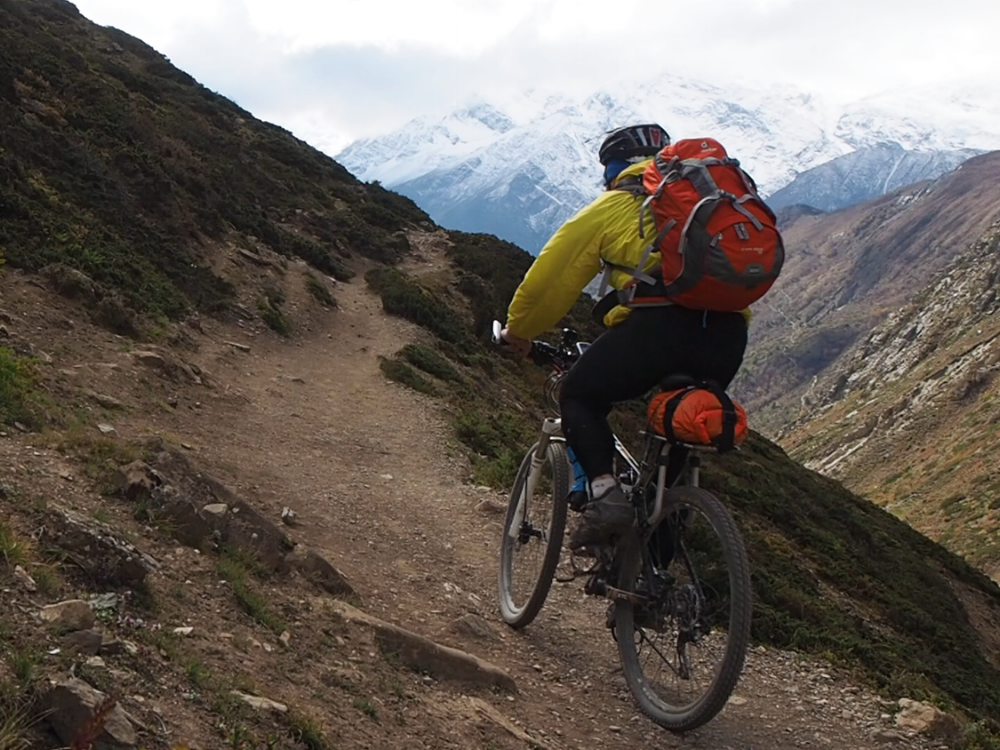
GIANT XTC 3 SLX 27’5-inch hard tail mountain bike (2015) with MAXXIS CROSSMARK tires.
After a comprehensive service at Himalayan single track in Kathmandu, I suffered no mechanical or any other problems on the ride, only replacing the rear disc pads in Pokhara as a precaution. I had a single puncture, and the tires held air for the entire trip without even the need for topping up, which seemed a little silly really.

Luggage
30lt Deuter Trans alpine 30lt backpack.
Thule pack and pedal rear rack.
10lt dry bag.
As is my custom for this level of bike touring, I stuck with a 30lt backpack, but because the possibility of extreme cold existed, added the rear carrier to accommodate a dry bag full of bulkier clothing.
The quality of the Deuter pack is excellent and it was well balanced and comfortable on my back. There was plenty of versatility in terms of compartments to organize all my kit. I packed everything in separate dry bags or zip lock bags for added protection, but mainly because it makes organizing kit so much easier.
I had heard mixed reports about the Thule rack, mainly that the bolts worked loose and need tightening a few times a day. This was not my experience, although I checked each morning, everything remained secure.
I also had a small bar bag for my cellphone and daily cash, but a tear in the side pouch caused me to loose a camera battery and my lovely penknife given to me by my son Dylan after our Bhutan cycle in 2015. I replaced this in Kathmandu before returning home.

Camera equipment:
Olympus - OM-D M-E1 Micro 4/3 digital camera
GOPRO Session
M-ZUIKO lens - Standard zoom 12-40mm f2.8 (24-80mm f5,6 FF equivalent)
M-ZUIKO lens - 17mm f1.8 (34mm f3.6 FF equivalent)
M-ZUIKO lens - 25 mm f1.8 (50mm f3,6 FF equivalent)
M-ZUIKO lens - 75 mm f1.8 (150mm f3,6 FF equivalent)
SLIK Mini pro - table top tri pod

I struggled terribly with taking a decision as to which camera set up to bring on the trip and on the morning I flew out from Lao, I still had both my Canon 5D and the Olympus micro 4/3 sets lined up next to each other. My final decision to go with the Olympus was based on the rationale that due to weight considerations, I would not be able to take the range of lenses needed to justify taking a full frame camera in the first place. With the Olympus, I was able to take 3 prime lenses and a good quality zoom at half the weight and bulk of the Canon with only one decent prime lens.
In retrospect, I never really missed having a full frame camera with me and I honestly cannot complain about the quality of the images I brought back. It was the right decision.

The other stuff
For me personally, there is something special about travelling on a bike that’s free of luggage. Somehow the set up maintains within my psyche a “Hey, I think I’ll just go for a quick ride on my bike” frame of mind. for me, I have this style of touring down to an art form, with plenty of luxury items included in the mix, loads of camera equipment and separate clothing for the evenings. In fact, looking at the list of items I took with, its difficult to imagine how I fitted it all in, but it was completely manageable, even comfortable. There was nothing I didn’t use, other than the “insurance items” such as spares, first aid and contingency stuff.

In particular, the electronics section appears to be over the top, but every item was used on a daily basis and made it possible for me to keep in contact with my family and friends, check my routes and even enjoy nightly entertainment in the worst of conditions. (Black Adder and Flight of the Conchords)

Overall route statistics

Distance - 1,013 km
Average distance per day - 63 km
Highest milage in one day - 154
Total elevation climbed - 14,420
Ave elevation climbed per day - 901
Most climbing in one day - 1,658
Highest elevation reached - 4,232 MASL
Lowest elevation reached - 103 MASL
Pt 1 - Nepal cycle - 2016 or "How I failed to cross the Thorong La, and does it even really matter?"
During 2015 my son Dylan and I cycled across Bhutan and into Nepal....
KATHMANDU TO BESISAHAR

During 2015 my son Dylan and I cycled across Bhutan and into Nepal via West Bengal, finishing in the capital city of Kathmandu (KMD). Every now and then huge Himalayan peaks would reveal themselves to us, towering above the swirling clouds at impossible angles in the distance. I vowed then that one day I would take a closer look. In 2016, I did.

On my maps I find a road leading up onto the Annapurna trekking circuit on which I should be able to reach up to around 4,000 MASL. My plan is to take this road up to the mountains and spend a few days exploring the area after which I would return to KMD via the central and southern regions. The complete circle would be just over 1,000 km providing me with an excellent cross section of Nepal culture and environment. I would rely on guest houses and tea rooms along the way for accommodation and food, just as Dylan and I had done during our 2015 trip.
Preparations in Kathmandu

I spend a few days of final preparation in and out of the craziness of Kathmandu ticking off the final items from my "to do" list, sorting out my trekking permits, assembling and preparing my bike. As arranged, I drop my bike off at Himalayan Single Track for a quick check up, and oh boy, how fortunate that I do. They completely strip down my bike checking every minute detail and replacing a number of worn parts. Much later that day, I leave with a bike that is only now, capable of the trip I have planned.

Face to face conversations with people from the cycle shop lead me to revise my route, including a much larger section of the Annapurna circuit with the added possibility of carrying my bike over the Thorong La (pass) at 5,400 MASL, descending on the opposite side to the road of my original planning. I never actually say that I will go over the pass, but in my heart I can feel a sense of real excitement brewing. Based on these changes, I buy a pair of waterproof trousers and an extra long sleeve tee shirt. I will now definitely need the rear rack which I fit with a thick dry bag to carry the bulkier items of clothing. Finally, I tick off the last item on my list. I am ready.
KMD to MALEKHA - 100kn - 889m climbing - 1,828 MASL max elevation

The first day’s ride goes off well, following a route slightly inland of the main highway, winding through terraced rice paddies, so typical of this central Nepalese region. Navigating the sprawling suburbs of KMD is a challenge, and I follow blindly the thin line on my GPS as it pulls me through small cobbled streets and exploded street markets.
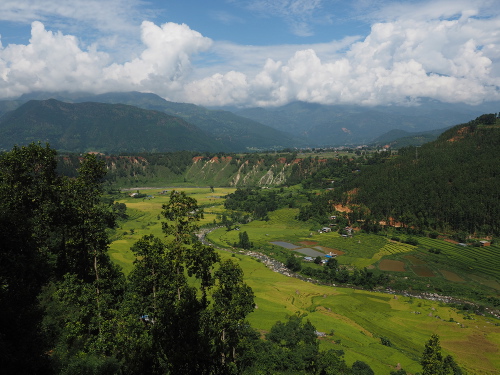
There’s a good deal of climbing followed by some very broken up and muddy downhill sections due to road works taking place. I’m still relatively unfit and as a result, suffer with cramps towards the end of the day. The first three days of a long ride are always difficult as you adapt mentally and physically to the new set of demands. My bike is a dream machine after its service and I nurse it through the muddy stretches, being sure to clean the drive chain a few times during the day and again in the evening.

While breakfast had been a western plate served against the stunning backdrop of the KMD valley, my lunch is by contrast, 100% local; rice, curried chicken, chili and dal, no utensils except for the grubby fingers of my right hand. The final 20 km along the main highway introduces me once again to the sheer madness of the Nepalese traffic, not quaint as in Vietnam or silly like Thailand, just lethal, as in juggling chainsaws. The road follows the river, but instead of remaining along the valley, climbs out at every opportunity. I am seriously overcharged for my hotel room, my own mistake for not checking the price first.

MALEKHU to DOME - 65km - 615m climbing - 450 MASL max elevation

Only 60km today, but it’s quite tough enough with 600m of climbing in energy sapping heat and humidity. Manic traffic completes the package although overall it’s pleasant enough, made more bearable with frequent tea stops along the route. By lunch time I have already settled into a small lodge / restaurant run by a lovely Nepalese family at the road junction town of Dome where I am able to catch up with washing and bike maintenance. I spend a frustrating few hours unsuccessfully trying to figure out how to convert my new pump to take a Pesta valve, eventually finding a work-around to solve the problem.

These towns are really something special, conforming very much to the picture I have in my mind of an ancient trading post. Full of color and character, the bright clothing of the Nepalese woman twirling between piles of merchandise and the fragrance of spices. These are the bazars found in almost every town, and they leave me with a feeling of excitement and awe, just to be gazing on such a scene.

My evening is spent within the peaceful warm company of the Nepalese family as they gather around my computer screen to glimpse something of life in Bhutan, Laos and South Africa. They give me two slivers of stone, one of slate, the other quartz, which they tell me is from their birth village, a village I will be passing on my way to Annapurna. Soon I will see for myself why there is such an intense and passionate connection between the Nepalese people and the towns of their birth. I fall asleep to sound of water softly gurgling below my window.
DOME to BESISAHAR - 44 km - 825 m climbing - 825 MASL max elevation

I wake to the sound of pouring rain and decide to sleep a bit longer, only to find out that the "rain" is actually the river running below my window. My rear tire is flat, so I replace the tube and clean up for breakfast, relieved that I had sorted out the pump the night before. Elevation will now replace distance as a measuring tool for a day’s progress. My route leads me away from the main highway so the road is small and winding, climbing steeply between rice paddies, waterfalls and swollen rivers. Tea stops are frequent and always shared with interesting local characters, the cinnamon spiced milk tea deeply refreshing even during the hottest part of the day.

I arrive at Besisahar around lunch time and look for a guest house. Accommodation is cheap at 300 Rupees, too cheap I think, so I walk across the road where I am asked 250 Rupees! I shrug my shoulders, go back to the first place, pay the 300 and check in. This will be standard practice throughout the Annapurna route, the only consideration is that you are expected to eat all your meals at the restaurant attached to the establishment and that’s where the overall price evens out.

The town is located at the end of the tar road, the beginning of the Annapurna trekking trail, and groups of foreign trekkers arrive throughout the afternoon. Lilly white spidery legs disappear into large clunky new hiking boots, North Face jackets and aluminum water bottles clipped onto webbing belts. They are for the most part sullen and unresponsive to my greetings. Maybe its because their journey from Europe to Besisahar is contained within the bubble of the tour group and they need more time to let go of their defenses. Traveling alone on a bike takes care of that transformation pretty much before morning tea on the first day. I repair the punctured tube from the morning, re check my gear and fall asleep to the light pattering of rain on the street.
