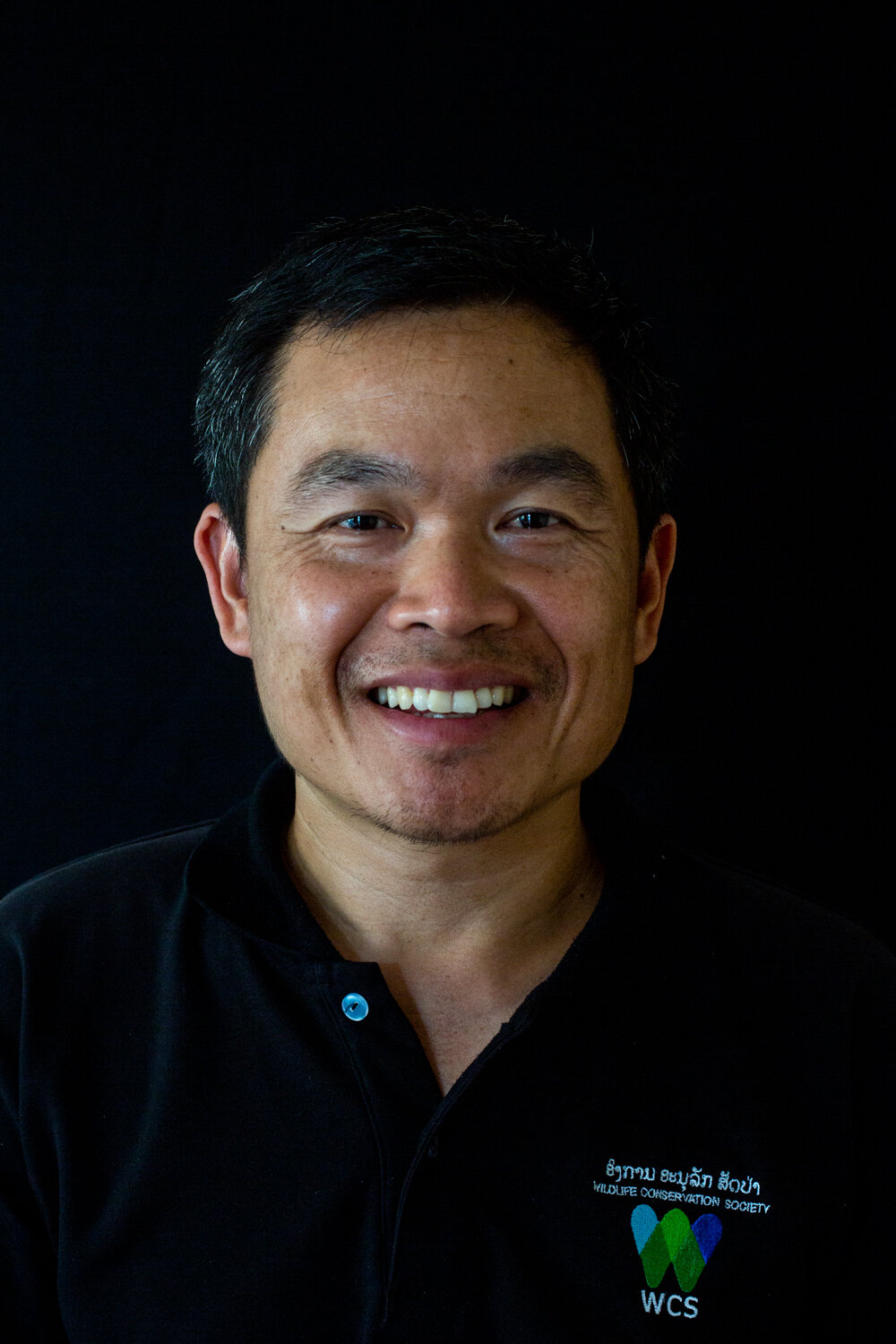
Sivilay Duangdala
From Monk to Manager
Over the past few years I have come to know Sivilay while working together on Nam Et - Phou Louey National Park. The NP is huge and complex, with more than 100 communities living in and around the NP, still largely dependent on natural resources from the park.
His journey from novice monk to program manager of the largest and most important protected area in Lao PDR, contains many valuable lessons. A few weeks ago while working up in Hiem, Houaphan Province, I got the opportunity to sit down with him and ask him about his journey.
This is what he told me.
Tell me something about your childhood?
Back then when I was child, we were a farming family in the village of Ban Namone in Feuang District of Vientiane Province. My family is very big, my parents have 13 children and I am the 12th child. Of course, we have a lot of competition to survive, so we all need to help the family by working on the farm. Back then, we didn’t have any machinery, so we used cattle and buffalo for plowing and other heavy farm work.
When I think back to that time of my life, I think that was real happiness, but I cannot go back to that same life now, because after I left the village, I got to improve myself and focus on service to the community and my education. So I think that back then I experienced real happiness, living with my parents and my family, enjoying the farming life in the village.

What was schooling like for you in the village?
Firstly, we didn’t have a kindergarten school, so my first schooling was at elementary school which lasted for 5 year, after which I moved on to study at secondary school. While I very much enjoyed my life in the village, at school we didn’t have any books, or even a library, so we only had verbal lessons and took notes from the teacher. Because we have a big family, education at a higher level is not always possible. Many of the village children are taken out of the school quite early, to help the family on the farm.
In my culture, which is the Lao Loom ethnic group, we believe if you have a lot of children in your family, then one of the children should enter the temple as a novice monk and work at becoming a monk. In this way, when someone from our family dies, then the monk can help to bring them from the place of evil, to the place of paradise. So that is why I was asked by my mother to be ordained as a novice monk and continue my education in the town. My father disagreed with my mother’s idea though, because he wanted me to help him with the family farm. In the end, I was the one to make the decision to become a novice monk, because I wanted to pay back merit, goodness to my parents for everything they had done for me, and I loved the through of a new vision for my life. In the end, I was the only one in my family who wanted to go.

What was your experience of being a Monk?
I was 16 years old when I moved to the Saphanthong Neua temple in Sisattanak district of Vientiane Province. It was in a quiet area of Vientiane, but of course as most of life was spent living as part of a remote village community, is was something new for me. I had to wake up early, around 4 am in the morning to prepare water for the senior monk to wash his face and take care of him. We would then clean the temple house and pray to the Buddha. At 6 am, at dawn, I needed to bang the gong, and then collect alms, offerings from the people who follow Buddhism in the town. We would then have breakfast, followed by prayer and meditation and then read and learn before lunch. After lunch, we would walk to school, because as a novice monk, you cannot ride, you have to walk everywhere. The school I went to was only for the monks around Vientiane, so it was quite a big school, accommodating around 1,000 monks.
Even though I was in the temple with many other novice monks, I felt isolated at the beginning. I missed my childhood during this time because I was always thinking about my parents. They would like me to do good things for them, so I was thinking that staying in the temple could give me opportunity to learn, so even though life in the in the countryside can hold a lot of freedom, in terms of education and opportunities it is very low.
Actually, in terms of thinking, there is a lot of freedom in the temple, only there is no freedom to travel, as I need to stay in the temple all the time. During the rainy season especially, for about three months, we are not allowed to overnight outside the temple. So in terms of gaining knowledge of the outside world, there was not so much opportunities. I noticed that foreigners travel to learn, but in my childhood, because I spent so much time walking in nature, nature is my biggest classroom. In the temple I can only experience one location inside and around the temple. So it was a very different type of life, totally different, but I have always believed that you need to have different experiences in life to be able to grow as a person.
I think I am lucky, because I have been placed in many different situations, a mix between my own personal design as well as the designs of others for me. For example, I did not choose to live in the countryside, that was designed by life, going to the temple was designed by my parents. Once I was in the temple, my life was designed by the senior monk, who was the head of the temple.
I spent 5 five years as a novice, and then 5 years as a Monk, so I was 26 years old when I left the temple. I learnt much about Buddhism and also about the world as a layman or general person, so it benefited me a lot because I learned about both sides of life.

How did you end up leaving the temple?
I could have decided to continue living as a monk forever, but I felt that I needed to go into the world. As a monk, you can only focus on educating people verbally, but you cannot act on what you have learned, through your labor or actions, so that's why I decided to leave. I thought that I had a satisfactory amount of knowledge as a monk in terms of Buddhist teachings, but I needed to pursue knowledge about the world. I thought that if I would like to help others then I would need to contribute physically to the world.
Leaving the temple was a transition process, because to catch up with the world outside, I wanted to learn English first. From around 20 years old I started to learn the abc’s and improved over time. I then applied to study the English special course at Don Doc University in Vientiane and finished the course during my final year of being a monk. In terms of funding for my studies, there are lots of donations from wealthy people who are Buddhists, or just from people who love Buddha and have faith, but as a monk, I also needed to do activities to raise the necessary funds.
As a monk during school, we needed to be careful in the class with the others. We tried to be a role model both ethically and in our grades. At University I needed to study hard so that I could show that I am better than the others, and I did. As a result, my grades were always higher than most. I had been a monk for almost 10 years which gave me an advantage over the other students, but when I took off my robe and became a layman, then I needed to help myself. I needed to earn my own money, so in the evenings I taught absolute beginner English for children and people with disabilities. In this way, I was able to make some income for my final year of education.
What did you do after leaving the temple?
After leaving the temple, I started working for the Lao Disabled Women Center in Vientiane which was supported by an NGO. I took care of e-mail correspondence for the center, and taught English to the persons with disabilities which was good because those people were disadvantaged and so I tried to help them to get knowledge about English. It was during this time that I met my wife who was also working there, teaching the woman handicraft weaving, using different styles and textiles. The products they made were sold to the international markets. During this time, I also volunteered to teach English at local schools and the university so that I could make extra money to support myself.
Around this time, I met a foreigner working for an international environmental NGO, and he told me about a position that was available as an accountant up in Houaphan province. I applied for the position, and after they called me for an interview, I was accepted for the position.
How was it working as an accountant?
Ok, so the work of an accountant was new to me, but I was lucky, because the organization had just hired a senior accountant, and she came up to the site and provided me with basic accountant training. I enjoyed the training and quickly learned the different tasks needed to be an accountant. Because I had been a monk, my number one value was and still is, honesty, transparency, and hard work. During this time, because my English was ok, I could meet with many people involved with the NGO, who would come and work on the protected area. There was one man in particular who worked on the eco-tourism products. Many times he was busy with training or other activities, and so he gave me the opportunity of being an interim eco-tourism guide. This gave me the chance to speak with the local communities around the park, and the people got to know and love me very much.
At that time, one of the eco-tourism staff was found to be dishonest, taking money from the communities. Because of this, he was not liked by the local communities and was asked to leave. The NGO director at the time as well as the Government counterparts wanted to promote me into that position because of my success with working with the local communities and so I was offered the position of senior ecotourism officer. I still had to perform my accounting tasks, so, by taking the new position, I placed myself in a very busy situation. It was during this time under the umbrella of the NGO program that I was able to shine, meeting with people from all around the world, scientists and general people, and to them I was able to express my vision, my attitude, and talk to them about my experience. Around this time, I was fortunate to meet the ambassador from the United States, and she noticed my performance and my attitude, so she nominated me to go to the United States to attend the international leadership program where I met with 18 representative from 18 countries around the world. This was in 2012, the first time I had ever left Lao. I was 33 years old. So I realized that progress in my work, my life, mainly came about through other people recognizing in me the qualities of trust, transparency and self-motivation, and these have led to me becoming a leader.
I continued to learn gradually about how to manage funds, eco-tourism and working with communities. A year or so after this, the program manager left the protected area and I was asked to take over his position on an interim basis. After a year in this position, I was appointed as the full program manager for the Nam Et – Phou Louey National Park. This is my current position.
How were you feeling about your life at this stage?
Looking back on my life up to this point I feel very lucky, like I am living a wonderful life. I can see different chapters, different experiences and different situations, all of which make me enjoy my life. If I had not become a monk, I would have been a farmer today. Of all the children in my family, only my younger brother has had the opportunity to learn, and one other has a small business, but the rest of the family have remained as farmers.
How would you describe your relationship to learning?
I have never viewed myself as a smart person, but I am motivated to learn, so when I am given an opportunity, I just take it and do my best. Even now, I still feel as if I'm not as smart as others, but what I do have is strength. I never ignore my responsibility and jump at any opportunity I am given, even if I know nothing about it. I love it! I think that any new experience will supplement my work and be good for my vision of helping the local people. Through this attitude I have gained a good reputation and respect. If I just speak, but don’t put my body to work, then it has no meaning. This is why I always place my physical body in nature when I can, if it’s a walk to a waterfall, or a field visit, I see this as an opportunity to communicate, to learn, to exercise my brain and keep my physical body active.
What do you see as your purpose in life?
Actually, when I was a child, I didn’t have a clear idea of what I could contribute to others, because I didn't have the ability, knowledge or the power of money to achieve anything. When I became a monk, I started to gain more knowledge, and started thinking, ok, now I can help people, teach them what is right, what is wrong in their life.
Now that I am older, I know that my purpose is to educate people. I combine Buddhism knowledge with scientific knowledge and practical actions. The Buddha taught people to follow science, the science of people, of nature, of wildlife. So for example, the main issue of the world is poverty, because poverty impacts on people, the environment and wildlife. I believe that if I would like to change things, then I need to change human behavior.
If we want to help people escape poverty, then we need to educate them. Look at the United Nations, they give materials and food to the poor, but that's not really how to help people get out of poverty. Knowledge, developing skills, using one’s mind to become educated, that is the way to get out of poverty. If I look at my own life, I can find a job easily now that I have knowledge. Take a disabled person for example, if they can learn to do weaving, then they can find work easily. So the answer to bringing people out of poverty is not found in things, or money, but in knowledge. In my work now, I teach the local community how to apply conservation principles to their lives, but I also teach them how to make a living. So that's why I say that my contribution to other people is providing them knowledge.

What lessons have you learned that have helped you throughout your life?
Sometimes my parents hit me if I did something wrong or made a mistake, and that taught me to be careful, because my parents would tell me;
“My children, we cannot live with you forever, because we are going to die before you as we are getting older. If we die, and you are not good people, your lifestyle could take you to prison”
So they taught me to be active, and to be good. At school, I cannot remember who my influencer was. We learned about geography and history, but actually it was my parents, my family life that was the most important influencer in my early life. They taught me the philosophy of life, how to live with others, how to avoid punishment. My brother was in jail, so I always remember that. For me, I don’t need to have laws to tell me how to live, and if the people of Lao act the same as my parents, then they will be successful. You don't need to study the law if you have been educated to not be harmful in your life. So I think the family is the key institution to changing the attitudes of people, but this needs to happen when we are young.
The real livelihood development work should not be done when people are old, but from when people are born, and then they learn, and keep gaining knowledge so they can survive independently. I think that by helping adults in the communities to develop livelihoods, we will not get to the root of the problem. The root of the problem is what happened when they were young, and it’s hard to change people’s behavior when they are already addicted to bad or incorrect behavior, same as with people who are addicted to drugs for example.
So with people who are poaching wildlife, its so difficult to change their behavior, maybe we can be successful with some, but not with all. In some families, children may have done something wrong, but the parents just support them and do not teach them what is right and what is wrong. This will establish a mindset for them about right verses wrong, and so they adopt a bad perception about the consequences of bad behavior. They believe that bad behavior is not serious, and that thinking becomes dangerous for them and to others.
What are you still wanting to achieve in your life?
I want my children to follow in my steps, that is something I would like to achieve. Then secondly, I would like to complete my master’s degree, that is my dream. Even though I know now that I am capable of doing my job, graduation to my masters will provide me with respect and honor within the scientific community and recognition as an important person in Laos. If you would like to help people, then you need to have power and influence.
Another reason why I want to get my master’s degree, is that I have been criticized in the past by skeptical Lao people in a similar position to me. They say things like:
“Sivilay?, Where did he come from? I don’t believe he can be effective in his work; he has only completed an English language program and never any formal scientific studies!”
But I have proved over many years already that I am good at my work, and even in my organization, there are people in lower positions than me, but with higher levels of education. People both inside and outside of my organization ask me for my opinions or to share papers that I have developed. So in the future, if there is a good organization focusing on working with the poor, using scientific information to fix society, then I will put myself in a high position in that organization.
Although actually, even though it is currently very important for me to get my masters, even if I don’t, I think I can still do good because I've been educated from when I was born. Through the different chapters and stages of my life I have gained a unique perspective and a variety of knowledge on different aspects of life, so I still have firm ideas regarding what I want to achieve.

How do you describe your relationship to the natural environment?
I always promote to my friends, relatives and local people that we come from nature, so we need to place ourselves within nature. Nature provides everything we need for life, so if you need to understand about rivers and how they flow, or about the rain, the soil, the biggest classroom for this, is nature.
In our body there is soil, wind, fire and water. When we die, we go back to nature, the wind back to wind, the fire to fire, water to water and everything back to the earth. Nature back to nature. So because our body is a part of nature, we need to take care of it by not cutting down the forest, by not throwing trash into the river, by not spoiling nature because it’s there for your life. So that is why I will teach people to love nature, that we don’t have a right to destroy it. If you destroy nature, you destroy yourself, so if you need to build a dam to make income for you or for your country, or cut stone for building your house, then you need to compensate for the damage. We can utilize nature, but in a sustainable way.
Some people view conservation as a block to economic development, but I see that conservation is an important part of economic development because as I already said, nature gives us everything we need for our lives.

How do you want to be remembered in your life?
I think that at the moment, some people will say that I am doing a great job, and other people who are looking to benefit illegally from our work will say bad things about me, made up bad things, because I don’t support them and their bad deeds.
My friends will say I am a wonderful person, an influential and powerful voice within conservation and in helping the poor to live and make a better life for themselves. They will say I am friendly, easy to get along with.
By the end of my life, my wish is that people will remember me as a someone who taught how to practice a meaningful life, how to earn an income, how to survive in the right way, not harming nature, not being involved with corruption or criminal activities, drugs or whatever is not good for society. So this is the message that I want to keep alive.

Finally Sivilay, what is your message to younger people starting out on their journeys?
Because I believe in education, I would like to encourage young people to learn, to gain different kinds of knowledge, to be good people. If you would like to have a life of wellbeing, then you need to be educated, not just education, but also experienced in practical deeds as well. If you have a foundation of education, then you can progress in your life, but if you are illiterate, or uneducated, then you can never reach your full potential.
Forgiving god
Forgiving God
Forgiving God – Losing my religion
A few year ago, a colleague asked me what I believed about creation, and I gave my standard answer about how it all comes down to whether or not you believe that someone was in control of the process or not, the “how” explained or still being explained slowly and surely by science. She was not that convinced and asked a number of questions which I couldn’t really answer. Anyway, it got me thinking and so I started doing some research, watched a few video discussions on “creative design” and other related subjects. All pretty interesting, and eventually this led me to the book The God delusion by Richard Dawkins. Even more interesting than the content of the book, was how the voices came pouring into my head,
“If you read this, bad things are going to happen to you”
I was genuinly scared of reading it, but I did read it, and soon after that, I also read God is not great by Christopher Hichens and I didn’t die or get sick, nor if I am truly honest, did it reveal anything new to me either. I don’t think I ever honestly believed (as an adult) in the many of the bible stories or claims, it’s just that through indoctrination from childhood, I was somehow incapable of questioning things written in the bible. Now I allowed myself to think clearly, and this act pried a small crack in the wall of my faith, a faith that previously had magically transformed fable and fallacy into an unquestionable (as in not allowed to be questioned) reality. I really believe that a part of my reasoning had been damaged, to the extent that I could believe what no rational person ever could, without undergoing some level of indoctrination, regardless of whether the intention was good or bad, in this case, good.
I can imagine a woman finding out that her husband has been cheating on her for years, suddenly can see the proof staring at her from so many small incidents, now as obvious as if they were done completely in the open. When looking at each of the incidents through “faith”, they can all be explained rationally, but once faith is gone, the only thing left, is the stark reality that her husband is a cheat, there relationship a sham.
This is very much my own experience of my deconversion process. The crack grew larger, until I was finally able to see clearly, for the first time, yes, the first time. Now, I am finally free to shout out, if it is so, that the emperor has no clothes. I don’t feel lost or lonelier than I did before, I don’t feel that I have cast off even the slightest moral restraints, or that I love any less or feel any less compassion for people. I do feel a little silly.
I’m sure that many would say that I have been negatively influenced by the books I have read or the teachings of people like Dawkins or Hichens, but the interesting thing is that it was really thinking back on two incidents that finally brought the reality home to me, that exposed the truth (as I now see it) and they had nothing to do with the origin of the universe, history of natural selection or even the every convincing augments of how discovery has slowly reduced (and still is) the number of aspects of life that could always only be explained by a supernatural power.
Both incidents occurred when I was a young boy growing up under the weight of church life. As a parent myself, I find that I am able to look back on myself as a child and see myself from the perspective of a father looking at his own son.
The first incident occurred during the years of sitting in the pews at the Assemblies Of God church at Harfield road when I must have been about 8 or 10 years old.
Unknown to both me and my parents at the time, I had developed a defect at birth, which made it almost impossible for me to sit still for any period of time without the gradual buildup of a dull pain in my groin. As a 10-year-old, I didn’t understand what was happening, and was far too embarrassed to discuss it with my parents, so I turned to god, having been taught how god loves us all, and that he even knows how many hairs we have on our head. How I prayed, at church, at night alone in bed, at school, how I asked forgiveness, thinking that I must have too much sin in me for god to listen. Yet, even within that spiritually saturated environment of Sunday morning church, nothing happened, so I suffered on. At school it was easier as I could wriggle around with just a hiding as side effect at times, and at night I would rock back and forward until I fell asleep. In church however, sitting in the front row and under the watchful eye of the congregation, I was at the full mercy of the pain. I discovered that if I pinched myself really hard then the pain would be slightly diverted, but mostly, I just went silently mad.
As a father, mortal and imperfect as I am, I can clearly see and his pain, fear and desperation, and on the other hand there is no questioning the innocent faith of a child, his pureness of heart and absolute trust in a god he was taught loved him better and more perfectly than any earthly father ever could. So then I thought how it is possible for God to be so uncaring. Of course, now I understand that it was not so at all, it was just that he never actually existed. This is a very good thing, for if he were real, then the implications of his lack of action, care or compassion, given his all-knowing and all-powerful nature would go well beyond any level of child abuse capable of any human father.
30 years later the problem was diagnosed and operated on, finally solving the riddle of the pain that followed me through my life.
The second incident was when I was a bit older, around 15 years old. My best friend had suffered his entire life from a speech impediment. I longed for a way to help him and remembered from church, the story of the lady who touched the hem of Jesus garment and how he healed her because of her faith. I knew that I had at least as much faith as that lady, probably more. So for two nights I prayed for him to be healed, I even fasted, at school only though as I didn’t want to tell my folks. Based on the words in the bible and the preaching and teachings I had been exposed to, I absolutely believed that he would be healed. I remember standing by the phone and having one last prayer before calling him, fully expecting to hear that he had been healed. Of course, no such thing happened.
If this was not a motive that was pure, or a purpose that was good, or a faith that was at least as big as a mustard seed, or the prayer of a righteous boy, then what could every really be on this earth? I guess looking back, I just feel like a bit of an idiot.
So with these 2 personal incidents, and my own human instincts as a father, I don’t need to go as far as proving evolution or sprouting clever philosophy to understand the truth, that god does not, could not, have existed.
Now that I am free to see clearly, without faith, without the wages of sin hanging around my neck, without the words of the prophets, without the rewards of heaven, without the loving voices of my mom dad and all the people in the congregation and the music groups and communion and christian academics and apologists, when I look at the face of god in this bare light, with the veil of faith set behind me, there is only an ancient crumbling statue, a stone relic from thousands of years ago, pointing to a time of ignorance and superstition, fable and fear.
This stone, patched and weary of all the modern-day plasterers, builders and painters, desperately trying to keep it from crumbling further, changing a doctrine here, updating scripture, arguing away the parts of the gospel that offend, but succeeding only in maintaining a mere silhouette when viewed through the veil I have just parted.
There can be no free will when the alternative is everlasting damnation, there can be no freedom while your thoughts are being constantly monitored, recorded for judgement day, there can be no unconditional love, when the wages of not loving, are eternal damnation and death.
Now, finally, there is no more condemnation
Now, I am no longer a slave
Now, the curse of original sin has been broken
Now, the chains of sin and death have been shattered
Now, the scales have fallen from my eyes
Now I can see the light
Now I am finally free!
It’s not, as Christopher Hitchens concludes, that god is not great, its simply that god is not, and within that understanding, it’s not so difficult to say:
“God, I forgive you”.